
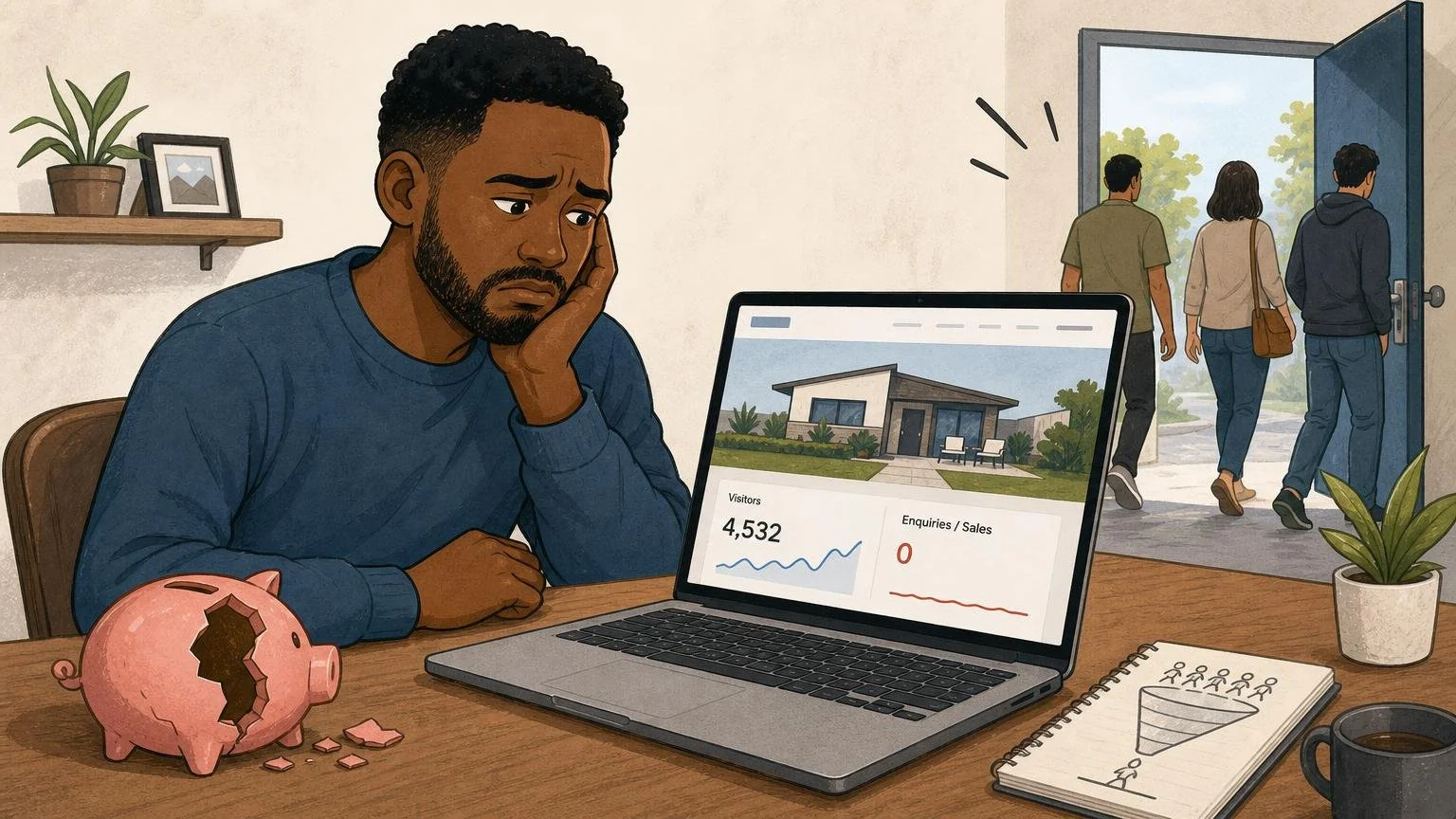
Your website is busy. The visitor numbers look fine on paper. But the calls, enquiries, and sales are not coming, and you cannot work out why.
Here is what is happening. A website that gets visitors but no customers almost always has a problem somewhere specific, traffic is not the problem. Somewhere between arriving and taking action, people are quietly leaving the site. In today’s article, I will show you where sites usually have these issues, how to find your problem points, and how to fix it without redesigning everything in a panic.
First, stop blaming the traffic
When sales are flat, the natural reaction is to want more traffic. More ads, more posts, more everything.
But if 100 visitors bring zero customers, 1,000 visitors will usually bring zero customers and a bigger bill.
Traffic is not your goal, my friend. A visitor who does something useful is the goal.
That useful action is called a conversion. A conversion is the step you want a visitor to take, such as calling you, filling a form, booking a slot, or buying.
If almost nobody converts, adding more traffic just pours more water through the same hole. And the answer is rarely to post more often on social media either. So before you spend another naira on reach, it is worth finding out where people are slipping away.
Think of your website as a funnel
A funnel is simply the path a visitor takes from arriving to becoming a customer. Picture yours with five stages, and understand that a visitor has to get through each one in order:
- Arrive on the page
- Understand what you do and whether it is for them
- Trust you enough to consider it
- Act, by contacting you or buying
- Hear back from you and finish the process
At every stage, some people leave. That is normal and it happens to everyone. The problem starts when almost all of your visitors leave at the same point. Find that point and you have found your leak. Let me walk you through the five places it usually hides.
Leak 1: The wrong people are Coming
Not all traffic is equal. If your visitors came from a viral post, a giveaway, or a search phrase that sounds like your business but means something else, they may have no intention of buying anything. A bakery that ranks for “birthday cake ideas” will collect plenty of readers looking for inspiration, not orders.
Check where your visitors come from and what they were actually searching for. If the traffic is curious rather than ready, the fix is not on the page at all. It is getting the right people to your site in the first place.
Leak 2: They cannot tell what you do
This one is more common than business owners like to admit. A visitor lands, spends a few seconds, and cannot quickly answer three questions: what do you offer, who is it for, and what should I do next. If your homepage opens with a clever slogan instead of a plain sentence, you are asking a stranger to work too hard, and strangers do not stay.
Say what you do in normal words, near the top, before the visitor has to scroll or think. I have seen genuinely good businesses lose enquiries for months simply because the page never said the obvious thing plainly. Clear beats clever almost every time.
Picture a dentist whose homepage says “Your smile, reimagined” in large letters but never states the city, the treatments on offer, or that they are taking new patients. Someone ready to book cannot tell whether they are in the right place, so they close the tab and search again. The slogan can stay. It just cannot be the only thing that greets a stranger.
Leak 3: They do not trust you yet
People do not hand over money or their phone number to a page that feels risky. If there are no reviews, no real photos, no clear location or contact details, and no sign that a real person stands behind the business, a careful visitor simply leaves and tries someone else.
Trust is built with small, honest signals: real customer feedback, pictures of your actual work rather than stock images, a real address or service area, and either clear pricing or an easy way to ask for it. You do not need to look like a big corporation. You need to look real, reachable, and safe to contact.
A small barber with three honest phone photos of real haircuts and ten genuine reviews will often win more bookings than a glossy page that shows nothing but stock images and big promises. People can sense the difference between a real business and a template.
Leak 4: The Site is too Complex
Sometimes people want to buy something but your website is too troublesome. The contact form has ten fields for a simple question. The phone number is an image that will not tap on a phone. The booking link is broken. The page takes so long to load that the visitor gives up before it finishes.
Most of your visitors are on a phone, so open your own site on your phone and try to contact yourself as a customer would.
If it is slow, fiddly, or confusing, that is a leak you can feel. Google says as much in its own guidance: it favours pages built for people, including how quickly and smoothly they load.
Leak 5: They reach out, then hear nothing
This is the quiet killer, and it does not live on the website at all. A visitor finally sends a message or calls, and the reply comes two days later, or never. By then they have already contacted a competitor who answered the same afternoon.
If your website is doing its job but customers still slip away, the leak may be your response time, not your design. Marketing brings people to the door. What happens after the knock is on you. Losing a customer you had already earned is a painful kind of wahala, and it is completely avoidable.
How to find your own leak
You do not need expensive tools to start. You need to watch the path honestly, as if you were a stranger who owes your business nothing:
- Open your site on your phone and try to become a customer, from landing to contact. Notice the exact moment it feels slow or confusing.
- Look at your analytics, the free visitor data from a tool like Google Analytics, and see which pages people leave from and how long they stay.
- Ask one person who does not know your business to find your price and contact you in under a minute, then watch where they hesitate.
- Check how quickly you really reply to a new enquiry, not how quickly you think you do.
Whichever step makes you wince is probably your leak. Fix that one first. Please do not rebuild the entire site to solve a problem that lives in a single place.
When it is worth getting help
You can handle many of these yourself, and I would honestly rather you tried before spending anything. But if visitors keep arriving and leaving and you cannot tell which stage is failing, that is exactly the kind of tangle worth a proper diagnosis. When people reach your page but do not act, the page, the offer, and the contact process usually need to be looked at together, not guessed at one at a time. That joined-up view is the real work behind good website design and conversion improvement.
If you have tried the obvious fixes and the leak is still hiding, you can book a paid 40-minute consultation for NGN 80,000. We will look at what is actually happening on your site, separate the symptom from the real problem, and agree on what to fix first. This is for diagnosis and direction, not a promise of a particular result.
If you would rather keep learning first, I share plain-English help with websites, content, and the business problems behind them on my Telegram channel.