You are offering a useful service, but not enough people are finding or contacting your business online.
Before you spend more money on ads or spend another month posting every day, I want you to check how a customer moves from discovering your business to contacting you. If any part of this process is missing, there is no need to waste your time and money on ads yet. This guide will help you find the problem and decide what to fix first.
Check where customers stop
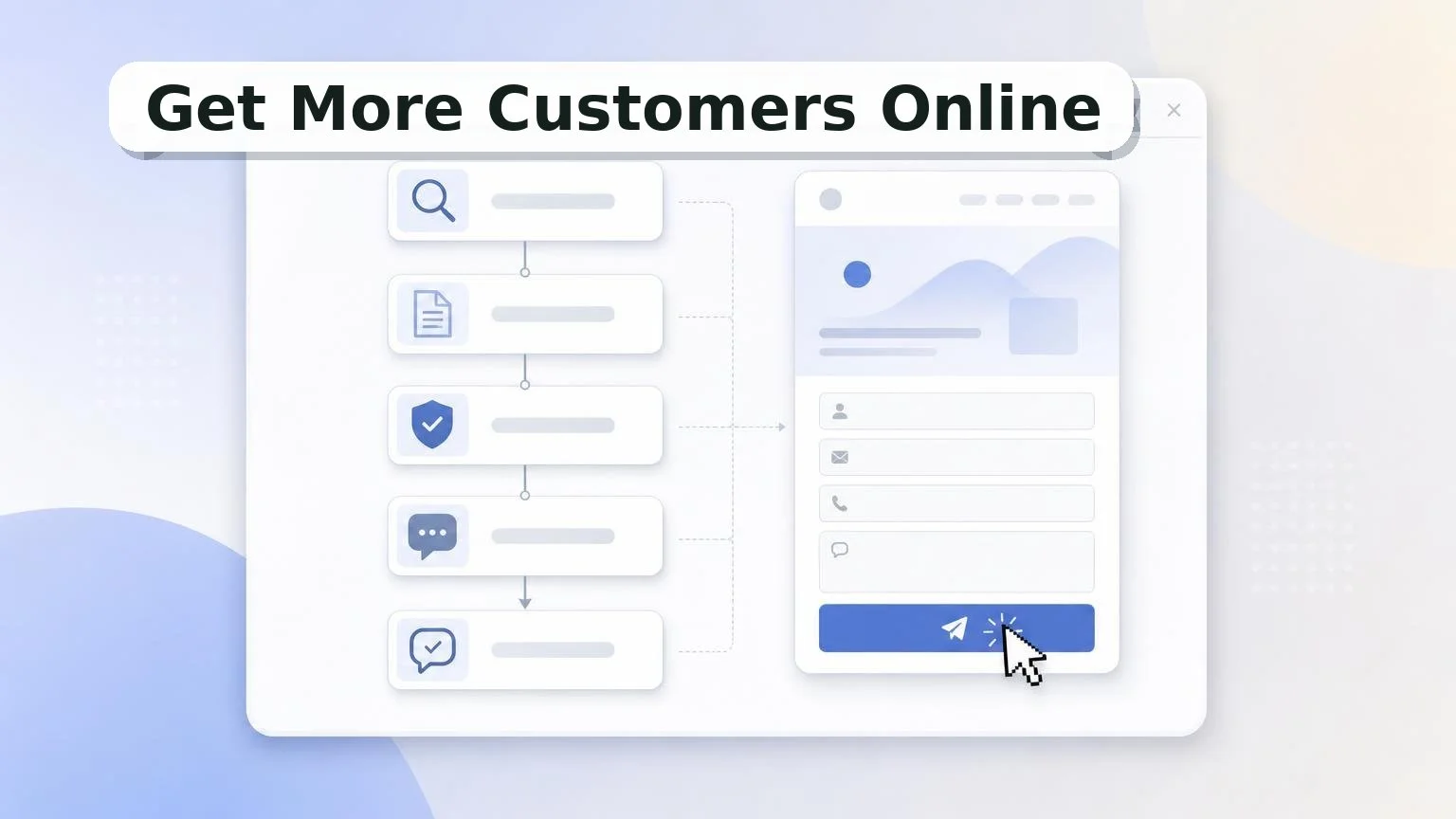
Getting more customers online involves five basic stages. A potential customer must be able to:
- Find your business
- Understand what you do
- Believe you can help
- Contact you without stress
- Receive a useful reply
You can have a problem at any one of these stages.
For example, a dentist may be easy to find on Google but have a website that makes booking difficult. A consultant may have an excellent website that nobody visits. A barber may attract plenty of Instagram views from people who live three countries away.
All three businesses need customers, but they do not need the same solution.
Read the five situations below and choose the one that sounds most like your business.
Few Customers find you online
This means you have a visibility problem. Your business does not show up in places where suitable customers search, ask for recommendations, or compare providers.
People see your business online but do not click
This can point to a message or offer problem. People may see your name without understanding what you do, who you help, or why they should pay attention.
People visit your page but do not contact you
The website may be confusing, slow, difficult to use, or short on proof. The contact option may also be hidden or inconvenient.
People contact you and then disappear
Check the price, response time, questions you ask, booking process, and what happens after the first message. The marketing may have worked. The next part of your business may be losing the customer.
You get enquiries but few make sense
Your message may be attracting the wrong people. It may also be too broad, making everybody think the service is for them.
Do not choose another marketing platform until you know which situation describes your business.
Decide which customer you want
“More customers” sounds like a clear goal, but not every customer is right for every business.
A good customer needs your service, can reasonably afford it, is in a location you can serve, and is ready to follow the process required.
Start by answering these questions:
- Which type of customer benefits most from this service?
- What problem makes that person start looking for help?
- Where is that customer located?
- What would make the person choose one provider over another?
- What usually stops the person from buying?
- Which enquiries waste the most time because they are a poor fit?
Write a one-sentence description of the customer.
For example: Busy parents in Mississauga who need a dentist with evening appointments.
Or:
Small companies that already have a website but receive very few suitable enquiries from it.
This description is not meant to exclude everybody else. It gives your marketing one person to speak to clearly.
If you try to write one message for everybody, the result is you have a sentence nobody remembers.
Make the offer easy to understand
A customer should not need advanced training to understand what you sell.
Your main message should explain:
- what you do
- who you help
- the problem you solve
- where you work, if location matters
- the next action to take
A weak message might say: We provide innovative, high-quality solutions tailored to your needs.
That sentence could describe a dentist, software company, laundry service, or person selling suspicious miracle cream. It tells the customer almost nothing.
A clearer version would say: We provide evening and weekend dental appointments for busy families in Toronto.
Or:
I help small professional firms turn confusing websites into clear pages that generate suitable enquiries.
Specific language helps the right person recognise that the service is for them. It also helps the wrong person leave early, which saves everybody time.
Try this simple formula: We help [type of customer] solve [specific problem] through [service].
Do not force the formula onto every sentence. Just use it whenever necessary to check whether the offer makes sense.
Test the offer in ten minutes
Show the first section of your website or social media page to someone who is not involved in the business. Do not explain anything first. Ask the person these questions:
- What do you think this business sells?
- Who do you think the service is for?
- What should somebody do next?
If the answers are wrong or uncertain, the message needs work.
This test is more useful than asking someone, “Do you like my website?”. People can like the colours and still have no idea what the business does.
Rewrite the message using words a customer would use. Google also recommends using the words people search for in important places such as the page title and main heading. That does not mean repeating the same keyword ten times. It means calling the service what the customer calls it.
Go and stand where your customers are
You do not need to be everywhere. You need to be visible in the places your suitable customers use when they are looking for help.
For many local services, that may include:
- Google Search
- Google Maps
- referrals
- local directories
- community groups
- a useful website
Google says local results are mainly influenced by relevance, distance, and prominence. Relevance means how well the business matches the search. Prominence means how well known or trusted the business appears to be. Complete business information, reviews, links, and accurate details can all help. You can read Google’s explanation of local ranking.
For a consultant or professional service, suitable customers may also search through LinkedIn, industry communities, recommendations, podcasts, YouTube, or detailed Google searches.
For a visual service, such as hair, food, events, design, or photography, Instagram and short-form video may help people inspect the work before making contact.
The important question is not, “Which platform is popular?”. Ask, “Where does my type of customer look when this problem becomes urgent?”
Choose one or two strong channels first. Five neglected accounts do not create a strategy. They create five places where your last post says 2023.
Match the channel to the buying process
A customer looking for an emergency plumber behaves differently from a company looking for a long-term consultant.
If the need is local and urgent, Google Search, Google Maps, local recommendations, and a working phone number may matter most.
If the service is expensive or complicated, useful articles, case studies, referrals, LinkedIn, email, and proper conversations may be more helpful. The customer needs time and evidence before deciding.
If the result is highly visual, photos and videos can help. A barber, event decorator, caterer, or photographer can show work in a way a written claim cannot.
If customers buy repeatedly, do not keep paying to find the same people from the beginning. With permission, use email, WhatsApp, reminders, or a simple customer list to remain useful and easy to contact.
You are looking for the shortest sensible route between the customer’s problem and your service.
Fix the page customers land on
Your website does not need to win a design award. It needs to help a potential customer make a sensible decision.
Open the page on a phone and give yourself five seconds. Can you tell:
- what the business offers
- who the service is for
- why somebody should trust it
- how to contact the business
If those answers are not obvious, improve the page before buying more traffic.
A useful service page normally needs:
- one clear main heading
- a plain explanation of the service
- the problems it solves
- who it is suitable for
- real proof
- a description of what happens next
- an obvious contact or booking option
Real proof means you should add your testimonials, examples of completed work, relevant qualifications, a clear process, or answers to questions customers repeatedly ask.
Do not use proof you cannot support. A row of company logos means little if nobody can explain what work was actually done.
The contact process also matters. Check that:
- forms actually send
- phone numbers work
- WhatsApp links open correctly
- booking pages are easy to use on a phone
- the customer is not forced to create an account unnecessarily
- the confirmation message explains what happens next
A conversion is the action you want a visitor to take, such as booking, calling, sending an enquiry, or joining a list. A beautiful page that produces no useful action still has a problem.
Run a 20-minute customer test
Do this before changing the whole website.
- Search for your service the way a customer would search for it.
- Check whether your business appears anywhere useful.
- Open your website on a phone.
- Read only the first screen and check whether the service is obvious.
- Click the main contact button.
- Send a test form, WhatsApp message, or booking request.
- Check what the customer sees after sending it.
- Confirm that somebody in the business receives the message. Then ask one person outside the business to repeat the test without your help.
Write down every point where the person pauses, becomes confused, or asks what to do. Those moments are more useful than an argument about whether the website looks modern.
Fix the biggest interruption first. A hidden booking button deserves attention before you add a new banner.
Give people a reason to trust you
Customers cannot inspect your service in the same way they inspect a physical product. They are often buying a promise about what will happen later. Trust helps them decide whether that promise is believable.
You can build trust by showing:
- the real people behind the business
- examples of the work
- how the process works
- honest answers to common questions
- appropriate testimonials
- relevant experience or qualifications
- clear contact and location information
- useful policies about payment, cancellation, or delivery
This does not mean the website needs a speech about being passionate, world-class, customer-focused, and committed to excellence. Every business says that. Show the evidence instead.
The same rule applies to social media. A page made entirely of promotional flyers tells people that the business wants money. It does not necessarily tell them what the experience will be like.
Show the work. Explain decisions. Answer questions. Let people see how the service solves a real problem.
Make contacting you easy
Some businesses spend money attracting potential customers and then make those people fight for a reply.
Decide who handles enquiries and what should happen after one arrives.
A simple process might be:
- acknowledge the enquiry
- ask the few questions needed to understand the request
- explain the next step
- send the price, booking link, or proposal when appropriate
- follow up politely if the person goes quiet
Keep a basic record of enquiries. This can begin as a spreadsheet with:
- the person’s name
- the service requested
- where the enquiry came from
- whether the person was suitable
- the next action
- the final result
A customer relationship management system, often shortened to CRM, is software for keeping this information organised. A small business does not need expensive software before it can start keeping proper records.
Without this information, a business owner may say, “Instagram is working,” when the profitable customers are actually coming from referrals or Google.
Do not run your ads too early
Paid advertising can place your message in front of more people. It does not automatically make the message convincing. Before paying for ads, confirm that:
- the offer is clear
- the page works
- suitable people already respond positively to the message
- enquiries receive proper follow-up
- the business can handle additional customers
If ten ad visitors don’t make any enquiries, sending another thousand people to the same page will bring a larger bill and the same wahala.
Ads are most useful when they amplify a path that already makes sense.
See how this works in practice
The following examples are hypothetical. They show how the diagnosis changes the solution.
A barber with plenty of views
A barber posts good haircut videos and receives thousands of views, but most viewers are outside the city. The profile does not clearly show the location, price range, opening hours, or booking method.
The first job is not more content. The barber should make the location and booking process obvious, improve the Google Business Profile, show work from real local customers with permission, and give nearby viewers a clear reason to book.
A dentist with website visitors
A dentist appears in local searches and receives website visits, but appointment bookings remain low. The website has a general homepage, a long list of treatments, and no clear information about new-patient appointments.
The dentist may need a focused page for the service people are searching for, clear location and opening information, suitable proof, answers to common questions, and a booking process that works properly on a phone.
A consultant with social media engagement
A consultant receives likes and encouraging comments on LinkedIn, but few serious enquiries. The content is useful, yet the service is described as “helping businesses grow” with no clear customer, problem, or engagement type.
The next step is to define the customer and problem, create a page that explains the service, show relevant proof, and give a suitable reader an obvious way to start a conversation.
The same number of views can hide three completely different problems. That is why diagnosis comes before activity.
Avoid the common distractions
Opening another social media account
A new account does not repair an unclear offer or a website that loses enquiries. Improve the strongest existing route first.
Posting only promotional flyers
Flyers can announce an offer, but they rarely answer the questions that make a cautious customer trust a service. Show the work, explain the process, answer questions, and share useful examples.
Copying a larger competitor
The competitor may serve a different customer, have a larger team, or spend more on advertising. Copying the visible activity does not give you the system behind it.
Reducing the price immediately
Customers may be confused, unconvinced, in the wrong location, or unable to contact you. A discount cannot repair all four problems.
Measuring followers instead of customers
A large audience can still produce poor enquiries. Track the people who visit, contact you, qualify, book, and buy.
Changing everything at once
If you rewrite the offer, redesign the website, change platforms, start ads, and introduce a discount in the same week, you will not know what helped. Make the most important change, observe the result, and continue.
Follow a simple 30-day plan
You do not need to repair everything on Monday morning.
Week 1: Find your weak point
Review how customers currently find you. Count the enquiries received during a normal period.
Record which sources produced suitable customers. Check whether the offer is easy to explain.
Test every contact and booking option.
Week 2: Repair the main page
Rewrite the main message in plain English. Make the service and intended customer obvious. Add real proof.
Simplify the contact process. Test the page on a phone.
Week 3: Improve one discovery channel
Choose the channel most suitable for the customer. This could mean:
- completing a Google Business Profile
- publishing a useful search article
- creating a clear LinkedIn post
- asking past customers for approved reviews
- forming a useful local partnership
- showing the service process in a short video
Week 4: Measure and adjust
Review:
- how many suitable people found the business
- how many visited the page
- how many made contact
- how many enquiries were suitable
- how many became customers
A lead is a person or business that may become a customer. A qualified lead is one that appears to have the right need, budget, timing, and fit. Do not celebrate a large number of leads if nearly all of them are unsuitable.
Measure what happens after the click
You do not need a complicated dashboard. Keep a weekly record of:
- suitable website visits, when that information is available
- phone calls, messages, forms, and bookings
- where each enquiry came from
- how many enquiries were suitable
- how many suitable enquiries became customers
- the value of the work won
Two simple calculations can help.
Your enquiry rate is the number of enquiries divided by the number of website visitors, multiplied by 100.
For example, if 100 people visit and five contact you, the enquiry rate is 5 percent.
Your close rate is the number of new customers divided by the number of suitable enquiries, multiplied by 100.
If ten suitable people enquire and three become customers, the close rate is 30 percent.
These figures are not useful because there is one perfect percentage for every business. They are useful because they show where your own result changes after you make an improvement.
Also record the source of each customer. Ask a simple question such as, “How did you find us?” Do not assume the last platform they clicked deserves all the credit. A person may see a video, read a Google review, visit the website, and then call after receiving a recommendation.
Know what to fix next
After the first month, the numbers should make the next decision easier.
If suitable people are not finding you, work on visibility. That may involve local search, useful content, partnerships, referrals, or carefully chosen advertising.
If people visit but do not contact you, review the offer, website, trust, and contact process.
If suitable enquiries arrive but do not become customers, examine pricing, response quality, sales conversations, availability, and service delivery.
Marketing cannot outrun broken operations forever.
Google’s own Search Essentials recommends creating useful content for people and using the words people actually search in important places such as the title and main heading. That is a better foundation than filling a page with repeated keywords. See Google Search Essentials.
You need one working path
Getting more customers online does not begin with posting every day or opening another account. It begins by building one clear path from discovery to contact and checking where people fall away.
Make the offer easy to understand. Show evidence. Remove unnecessary steps. Reply properly. Then invest more in the channels that bring suitable people.
Posting fourteen more flyers will not repair a contact form that never sends.
Get practical help
If you want more plain-English help with websites, SEO, social media, advertising, content, and the business problems behind them, join my Telegram channel.
If you already have a clear website, SEO, content, or marketing project, you can book a free one-on-one discovery call. I will ask a few questions, assess whether I can help, and explain the most sensible next step.
If the problem is more complicated and you need focused diagnosis, you can book a paid 40-minute consultation for NGN 80,000.