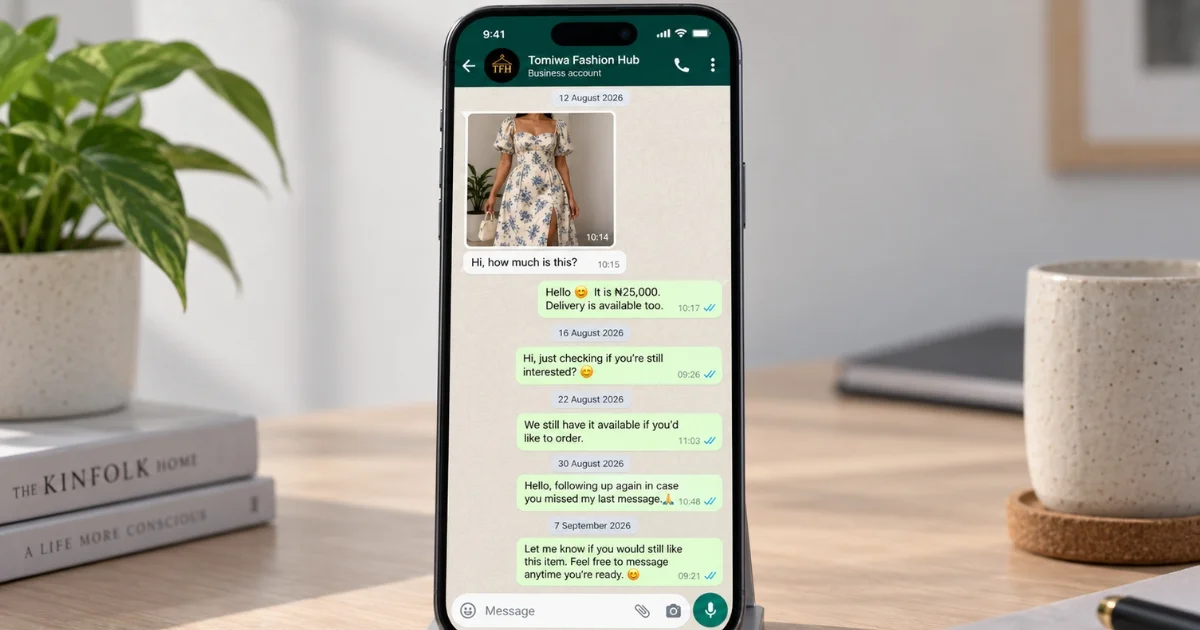
Every day, businesses get this kind of question from their DMs: “How much?”. Only a small percentage of those asking this question actually buy the product.
You might reply fast, but most of them will read your price and never reply again. In plain English, they ghost you.
So if you’re wondering why customers ask for your price and then ghost you in 2026, I’m going to give you an honest answer based on what I have seen working on businesses’ marketing.
Some of those people did not plan to buy from you in the first place, that part is normal because I have seen it many times. But a good number of them left because of what happened between their question and your answer. And if we fix that part, you will make more money.
Enough introduction. I’m about to explain what “how much?” really means, why people disappear after you reply, and how to answer so more of them stay in the conversation.
What “how much?” really means to a customer
“How much?” is a short interview. The person on the other end wants to know if you’re in their price range.
Many business owners take it personally. They assume the person is a cheap client that is not serious. Most of the time, the person is just busy.
They have probably sent the same message to four or five businesses at once. Now they want to shorten the list quickly.
Imagine that you are a bride in Manchester looking for a wedding photographer. You will send one message to six photographers and keep the ones who answer clearly and fit your budget.
So when someone asks “how much?”, they’re really asking two things. Can I afford you? And is it easy to buy from you?
Your reply answers both, whether you plan it or not.
Why customers ghost after you send the price
Some people will always disappear. Budgets change. A cousin offers to do the job cheaper. Life happens.
But when most of your enquiries vanish right after the price, check these first:
- You made them wait. By the time you replied, they had already found someone else.
- You sent a number with nothing around it. “£450.” That’s all. With no idea what’s included, £450 looks expensive.
- You answered a question with a question. “What’s your budget?” or “Can we get on a call first?” The customer asked something simple and got homework.
- The price shocked them. Nothing on your profile, posts, or website prepared them for your range.
- You gave no next step. The price arrived and the conversation just stopped. Nobody told them how to book.
Speed deserves extra attention.
In a well-known study, researchers audited 2,241 US companies and measured how long each took to respond to a web enquiry. Harvard Business Review reported that firms that tried to contact the enquirer within an hour were nearly seven times as likely to have a meaningful conversation with a decision maker as firms that waited even an hour longer.
That study is from 2011, and it looked at website enquiries, not Instagram or WhatsApp messages. I still doubt customers have become more patient since then.
The same slow reply that kills a DM also kills a website enquiry. It is one of the reasons I cover when I explain why your website gets visitors but no customers.
Price shock usually has a different cause. If your content pulls in people who want the cheapest option, and your price sits in the middle or top of the market, the gap will show up in your inbox. That is the same problem behind accounts that get plenty of views but no customers. The wrong people are paying attention.
How to reply when a customer asks “how much?”
A good price reply is short. It gives the number early, gives the number a reason, and points to the next step.
Use this formula to win the sale:
- Thank them and give the price, or a clear range, in the first line.
- Add one line on what’s included or what changes the price.
- Add one piece of proof, such as a review or an example of similar work.
- Ask one easy question that moves things forward.
- Tell them exactly how to book.
Here’s how that could look for a cleaning company in London. It’s an example, so swap in your own details:
“Hi Sarah, thank you for getting in touch. A deep clean for a two-bedroom flat is £180 to £220, depending on the oven and carpets. That covers two cleaners for about four hours, with all supplies included. You can see what recent clients said in our Google reviews here. Which area are you in, and what date works for you? Once I know, I can hold a slot for you.”
The price is in the second sentence.
The customer knows what they get, can check other people’s experience, and has one simple question to answer.
Don’t skip the proof. A stranger has no reason to trust your price yet, and reviews now carry so much weight in that decision.
If your price truly depends on details, give a range anyway, then ask for the one detail you need. “Between £800 and £1,500, depending on the size of the room. Roughly how big is it?” A range with one question will keep the customer talking.
“It depends” with no number makes them feel handled.
If you get the same question twenty times a week, save your answer.
WhatsApp Business lets you save up to 50 quick replies and send one by typing “/” in a chat. Check whether the inbox you use has something similar. Then edit the saved reply to add the person’s name and details before you send it. A pasted reply with the wrong name is worse than a slow one.
What if they still go quiet? Send one follow-up after a day or two. Keep it light and useful. Something like, “Hi Sarah, just checking you got the quote. I have two slots left next week if you’d like one.”
Then stop. One follow-up is good service. Five follow-ups feel like pressure.
Should you show your prices publicly?
You’ve seen the posts. A beautiful product, a nice caption, and then “DM for price.” I think that’s a stupid approach (forgive my language).
I think most small businesses should show a starting price or a range. “From £120.” “Most projects cost £2,000 to £4,000.” Something that tells a stranger where you sit.
Publishing a range filters people before they message you. The ones who still reach out have already accepted your ballpark, so the conversation starts from a better place. You also spend less time answering people who were never going to buy.
Hiding the price does the opposite. It makes the customer do extra work just to find out if they should care. Some will message and ghost. Many won’t even message.
Some owners worry that competitors will see their prices. Your competitors can already send you a DM and ask. The only people you are really keeping out are customers.
There are exceptions. If every job is fully custom, like bespoke furniture or a large renovation, a fixed price may be impossible. Even then, “Projects usually start from” gives people a reference point.
Put that starting price where people already look: your website, your Instagram highlights, your Google Business Profile, or your WhatsApp catalogue. A page that shows what you do, roughly what it costs, and how to book will answer the question before anyone has to ask.
The bottom line on customers who ghost
Before you change your prices, measure what’s actually happening.
For the next two weeks, write down every “how much?” message. Note how long you took to reply, whether they replied after seeing the price, and whether they booked.
The pattern will point you to the fix. If people vanish before you even answer, your reply time is the problem. If they vanish right after the price, look at how you present it. If the right people rarely ask at all, the problem sits earlier, in who your marketing attracts, and you need a wider plan to get more customers online.
This kind of diagnosis is most of the work I do with businesses. Sometimes the owner blames the price, and the numbers show the customer left before the price even arrived.
If you’ve fixed your replies and enquiries still disappear, the problem may sit deeper, in your offer, your pricing, or the people your marketing reaches. You can book a 40-minute Marketing Clarity Session with me. We’ll look at what’s happening, separate the symptoms from the real problem, and agree on what to fix first. It’s for diagnosis and direction, and it won’t promise a particular result.
If you’d rather keep learning on your own for now, join my Telegram channel. I share practical ideas you can use without needing a marketing dictionary.