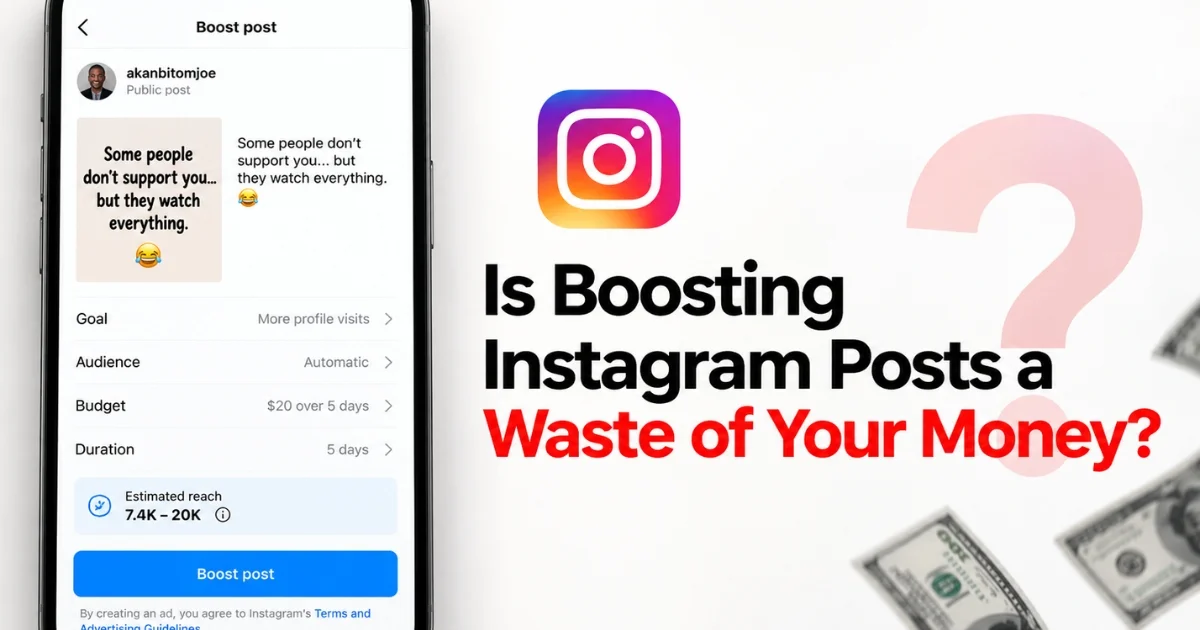
Before you go far, the short answer is that, sometimes it can be a waste of money.
I wish someone told me this earlier when I started running ads. I used to think that if I spent money on boosting a post, the money would automatically bring me followers, leads, and sales. Then I had to find out that paid social can be either a high-performance amplifier or an expensive loudspeaker for no one to hear, depending on what you feed it.
And if you have ever asked, “I boosted this post for a week and got almost no traction,” you are probably skipping the first and most important step. Boosting is not a growth hack. It is a distribution decision.
Let’s start with the reality of Instagram ads in plain words.
Boosting posts is not magic
Every boosted post is a transaction. You are buying the chance for more people to see your content. But attention without intention is like printing business cards and scattering them in the wind.
Some will hit, some will not, and most will disappear in the noise.
The people who get results from boosts are the ones who treat boosting like experiments. They ask questions like:
- Who is this post talking to?
- What is the person supposed to do after seeing it?
- How will I know this ad helped or hurt?
- What will I change next week?
Most people skip these questions and go straight to “spend more.” And that is where the frustration begins.
When boosted posts work well
Boosted posts work when:
- Your offer is clear and easy to understand in under ten seconds.
- The post itself solves one specific problem.
- The target audience is specific, not broad.
- There is a clean next step after click, usually a message, form, or booking link.
- You have a way to track what happens after the click, not just impressions.
For example, if you run a social media agency and you have a post explaining “3 ways to reduce your ad cost this month,” a smart boost can place that advice in front of business owners who are already spending on ads.
If the people who click then receive clear next steps and a reason to trust you, you can quickly convert. If your page is vague, with no clear service message and no clear CTA, most of those paid clicks become one-time visits.
When boosting becomes wasteful
There is a common pattern I see often. A founder posts something good, boosts it, gets good early engagement, and then keeps pushing the same post to new groups of people. That is like throwing a perfect first date at every audience without preparing the same conversation for each one.
Each audience has its own context. A new entrepreneur in Lagos is not listening to the same hook as a founder in Accra. A boutique owner has different pain points than a coach. If your boosted post does not speak differently to these groups, your budget gets diluted.
Another wasteful pattern is boosting emotional content that performs well organically but does not support your sales funnel. Posts that get laughs are great for reach but often do not generate qualified leads. If your goal is revenue, you need to boost value that leads to decisions, not just engagement.
The first rule: test what to boost before you spend big
Do not start with “boost” from the top of your dashboard. Start with organic performance data. Let your best posts reveal what your audience already trusts. Here is a simple workflow:
- Publish 3 to 5 posts in your niche style, with clear CTAs.
- Wait 24 to 48 hours and check comments, saves, shares, and saves-to-click ratio.
- Choose only the post that starts good conversations.
- Split test small budget versions with slight variations in audience and headline.
- Pause anything that fails to improve click and lead quality after 2 to 3 days.
This removes the guesswork. You are no longer paying for hope. You are paying for signals.
What to target if you are unsure
Not sure where to begin with audience targeting? Start with this practical order:
- Warm audiences: people who visited your profile, watched videos, or engaged before. They know your name.
- Lookalike audiences: people similar to your best customers, not everyone.
- Interest-based audience: narrow around one pain, one industry, one role.
- Broad testing: only after the first two layers are performing.
That is the opposite of common behavior. Most people go broad first and burn budget before proving relevance. You should move from high-probability to exploratory.
Common mistake: boosting content that does not convert naturally
If a post is already weak as a normal post, boosting it rarely saves it. You can polish, yes, but paid distribution cannot replace missing clarity.
Before boost, ask: does this post teach? does it relate to a real pain? does it include a direct ask? If two out of three answers are no, rewrite first.
Use the money split wisely
For most local businesses, a practical split is this:
- 50% for short tests and audience discovery.
- 30% for proven winners that generate leads.
- 20% for retargeting and nurture.
This keeps you from becoming emotionally attached to the first winner while still giving your sales pipeline continuity.
Creative and copy that gets better with more money
People often assume they can keep same ad creative and just raise budget. Usually, the opposite is true. Creative fatigue happens. The same image gets ignored after repeated impressions. Rotate in subtle variations:
- Different first lines
- Different hook format
- Different proof style: text, screenshot, mini case
- Different CTA tone
Small changes give you far more signal than big budget jumps.
How to know if it is a waste
Set a simple rule. If the boosted campaign does not beat your organic baseline by improving a useful metric in one week, stop and rework the post. Useful metric is not follower count alone. Use your own objective:
- For sales: number of qualified leads booked
- For content authority: saves, shares, DMs, replies
- For brand awareness: profile visits and video watch time
If the same post gives you traffic with zero meaningful follow-up, that is not growth. It is a vanity event.
Cost control and sanity control
Many people waste money because they do not define a stop point. Decide your comfort ceiling before launching. “I will pause after $50 per qualified lead,” for example. That one line saves hundreds. Without it, you will keep spending in hope mode.
And do this: schedule a weekly review that includes comments and questions from your paid traffic. Sometimes your best optimization insight is not from analytics. It is from what people ask after seeing your ad.
Case scenario: when boosting is not for you
Suppose you have a startup with no clear offer and no landing conversion system. If someone clicks and lands on a cluttered page, no amount of boosting will create serious results. In that case, first fix your conversion path, then budget. You may still use paid testing, but not as your first move.
Suppose you run a service business with low purchase frequency. You should likely prioritize lead quality over click volume and combine boosted posts with remarketing and DM follow-up. High volume may look impressive but can overwhelm your team.
The truth in one line
Boosting is only a waste when the strategy is weak and the offer is unclear. If your message is sharp, your audience specific, and your action path clean, boosting can be one of the fastest ways to turn attention into conversations.
So ask yourself the first thing every time before spending:
“Am I paying for attention, or am I buying a real next step for my business?”
If you want a simple rule, try this for your next three boosts: one test, one metric, one stop condition, one rewrite loop. You will either get a better system or a clearer decision to pause. Either way, you win.