You launched your website a few weeks ago, added some pages, and you keep refreshing Google to see where you rank. Still nothing.
How long is SEO meant to take?
SEO (Search Engine Optimization) takes months before showing tangible results, not weeks. Most new sites see the first small movement in three to six months, real results across six to twelve, and the strongest returns after a year of steady work.
If you run a new website and want a realistic SEO timeline, here is what to expect and how to read the early signs, without the page-one-by-Friday promises.
Why SEO takes time
SEO is the work you do to make your website easy for Google and people to find and trust. A new site starts with none of that trust.
Google has to find your website pages, find out what each one is about, then decide whether to rank you above businesses that have been around for years. That takes time and evidence.
Google has said as much itself. Its long-standing advice, from one of its own engineers, is that SEO usually takes four months to a year to show results. You can read the fundamentals in Google’s SEO starter guide.
A realistic timeline for your site
Every site is a little different, but a new site tends to move through familiar stages.
In months one to three, Google is mostly finding and filing your pages. You might see a few impressions and the odd visit for your business name. It feels like nothing. Something is happening.
In months three to six, if you keep publishing useful pages, you start ranking for longer, specific phrases and get your first real search visitors. By six to twelve months, a consistent site can rank for harder terms and bring steady enquiries.
Your starting point matters. A local dentist targeting one city moves faster than a shop chasing the same national terms as a hundred bigger rivals.
What SEO looks like in real life
If a new physiotherapy clinic in Bristol launches a site with clear service pages and a short blog, here is what will happen.
For the first two months, the searches it shows up for are mostly its own name. Around month four, it starts appearing for phrases like “sports massage in Bristol,” several positions down the page.
By month seven, one or two of those pages reach the first page, and search enquiries begin to trickle in. By month twelve, the clinic ranks for a dozen local terms and takes steady bookings without paying for each click.
No single day changed much. The results came from useful pages stacking up over time.
What Makes SEO Timeframe Faster or Slower
You cannot buy your way past the wait, but you can remove a lot of the drag.
Go after specific, lower-competition searches first, the ones people type when they are close to buying, which is the heart of basic SEO. Fix the technical basics early, like site speed and how pages read on a phone.
Earn a few genuine mentions and links from real, relevant sites. Publish on a schedule you can keep. The aim is simple: give Google steady evidence that real people find your pages useful, month after month.
Some habits drag it out. Buying cheap links, publishing thin AI pages, or stuffing keywords can get you penalised and set you back further than doing nothing.
How to know your SEO is working
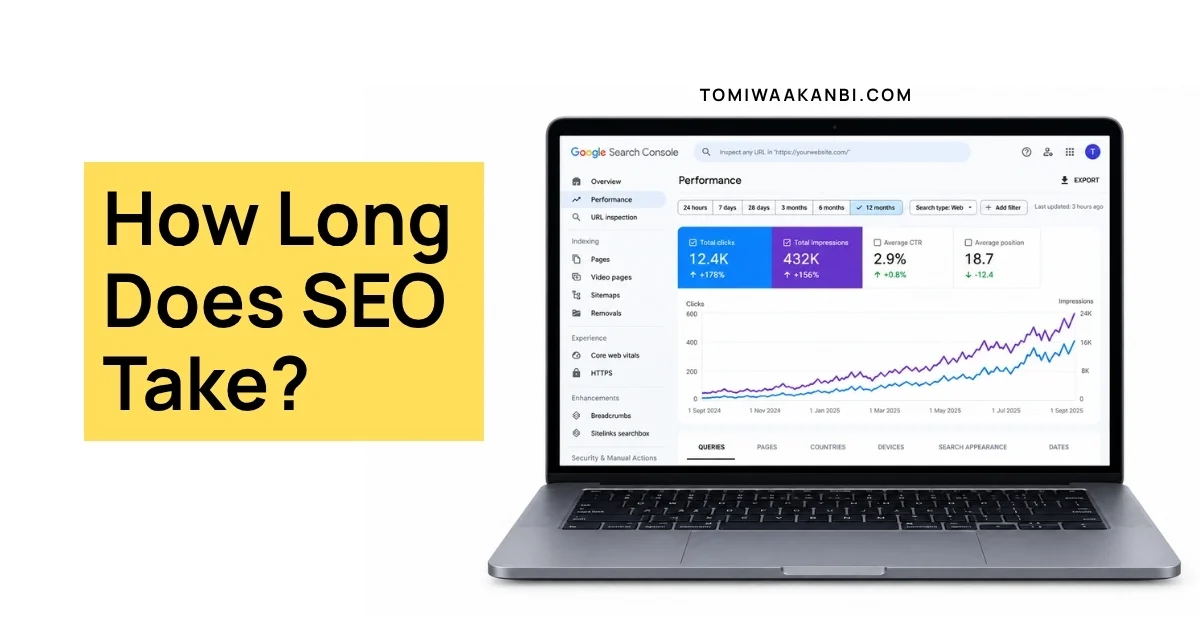
Sales are the last thing to move, so watch the earlier signals first. Open Google Search Console and track these in order:
- Impressions: how often you show up in search at all
- Clicks: whether those listings earn visits
- Queries: the exact phrases you appear for
- Buyer-intent queries: when those phrases match what a paying customer would type
When the searches you show up for start sounding like a customer, customers are usually close behind.
Good early progress looks like a growing list of terms you appear for, even low down, and impressions climbing month on month. Being stuck looks different: months pass with no new terms and no rise in impressions. That is the sign to review the work, not to abandon it.
The mistake that resets your progress
The fastest way to make SEO take forever is to keep starting over.
People publish for six weeks, see little, then rebuild the site, rewrite every title, or drop it for the next tactic. Each reset sends Google back to the start of understanding you.
Pick a direction, publish useful pages on a steady schedule, and give them time to mature.
What to do while you wait
Because SEO is slow, do not lean on it alone at the start.
While your pages mature, bring in customers through faster routes like referrals, social content, or paid ads.
SEO is the long asset that lowers your cost of getting found later, so treat it as one part of a wider plan to get more customers online. And make sure the traffic it earns lands on a page that can convert, or you wait months only to lose visitors who never become customers.
Think of the early months as building an asset. Every useful page you add keeps working long after you publish it, unlike an ad that stops the moment you stop paying.
So, how long will it really take?
For most new sites, expect early movement in three to six months, meaningful results across six to twelve, and the best returns after a year. Local, specific goals come sooner. Broad, competitive ones take longer.
Do the work on a steady schedule, watch the right early signals, and resist starting over. That patience is what turns search into a channel that brings customers for years.
If you cannot tell whether your SEO is on track or stuck, a quick review can save you months. You can book a paid 40-minute consultation with me, and we will check what is working, what is wasting time, and what to do next.
Prefer to keep learning first? I share plain-English help like this on my Telegram channel, and you can see how I help businesses get found and chosen.