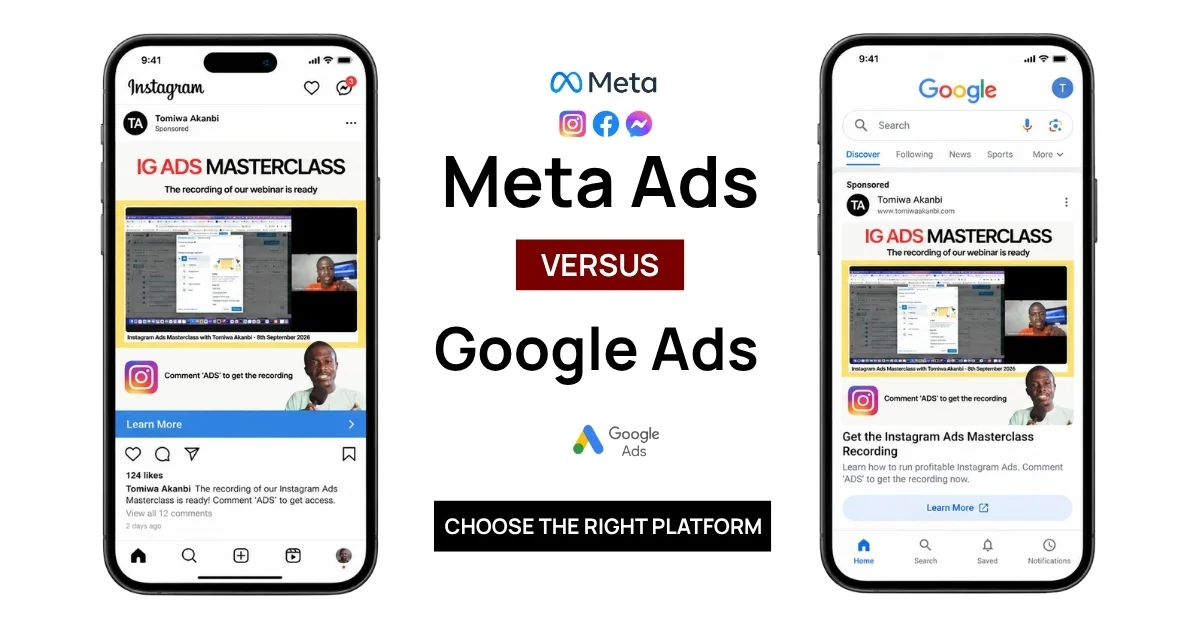
You have set aside some money for advertising, but one question is stopping you from spending it. Should you use Google Ads or Meta Ads?
Here is the short answer. Use Google Search when people are already searching for what you sell. Use Meta when you need to put your offer in front of people who were not looking for it.
Your budget matters, but the way your customers buy should guide the first decision. Neither platform is automatically better. They do different jobs, and choosing the wrong one is how businesses burn money and decide that advertising does not work.
The one difference that matters
Google Search Ads reach people who are already looking for an answer. If someone searches for an emergency dentist in Lagos or a tax accountant near them, your ad can appear at the moment they need help. You are paying to be found by someone who already has a reason to act.
Meta Ads, which run across Facebook and Instagram, work differently. They place your offer in front of people based on who they are, where they live and what they appear to care about. You are paying to create interest during a scroll.
Catching demand and creating demand are different jobs. Most of the decision comes back to that one distinction.
Quick check: Are people already searching for what you sell, or do they need to see it before they want it?
| Choose Google Search when | Choose Meta when |
|---|---|
| People already search for the service | People need to discover the offer |
| The need is clear or urgent | The purchase is visual or emotional |
| Your offer is easy to describe in words | Your offer is easier to show |
| You want high-intent enquiries | You want to create awareness or demand |
When Google Search Ads make sense
Google Search is usually the stronger starting point when people actively search for what you offer.
This suits services such as towing, plumbing, dental care, legal help and accounting. The person already knows what they need. Your job is to appear at the right moment and give them a clear reason to choose you.
It also works well when your offer has a simple, searchable name. If a stranger can type what you do into a search bar, Google Search can connect you with someone who already has intent.
When Meta Ads make sense
Meta is often the better starting point when people need to see the offer before they become interested.
A new skincare range, a property launch, a coaching programme or a local event can benefit from a strong picture or video that creates curiosity. People may search for the general category, but they will not search for your particular offer until they know it exists.
Meta also works well when the offer is visual, when emotion influences the decision, or when you want to reach people who visited your website but did not act. If your business needs to build desire rather than answer an urgent search, Meta may be the better place to begin.
Do not compare click prices alone
Business owners often compare the cost of a click instead of the cost of winning a customer.
A Google Search click may cost more than a Meta click, although the difference changes by industry and location, as WordStream’s advertising benchmarks show. That does not automatically make Google the more expensive choice. A Google Search click can come from someone ready to buy, while a cheaper Meta click may come from someone who is only curious.
Judge both platforms by what you pay to win one real customer. That is the number that matters to your business.
Fix the destination before increasing the budget
An ad only brings someone to your door. What happens next decides whether you make money.
If the page is confusing, slow or gives no obvious next step, you have paid to send a ready customer to a locked door. This is one of the main reasons a website gets visitors but brings no customers.
Make sure your website is clear and your offer is easy to understand before you increase your advertising budget. Ads are fuel. If the customer journey is leaking, more money will make it leak faster.
Ads get attention, but proof builds trust
Neither platform can buy trust for you.
An ad can put you in front of the right person and still lose them if they cannot find proof that your business delivers. Before buying, many people check what previous customers have said. That is why customer reviews can carry more weight than an advert.
Use the ad to earn attention. Let your reviews, examples and clear offer do the convincing after that attention arrives.
Which one should you choose?
You can settle the first decision yourself. Answer these questions:
- Do people already search for what you sell, or do they need to discover it?
- Can a stranger understand the offer in one line, or does it need to be shown?
- Do you need enquiries from people ready to act, or are you building interest over time?
- Can the page receiving the clicks turn a visitor into an enquiry?
If people search for your service and need it now, begin with Google Search. If you need to create desire in front of the right audience, begin with Meta. Start with one platform, prove that it brings real customers, and then consider adding the other.
My recommendation
The real question is not simply Google Ads or Meta Ads. It is how your customers decide to buy and which platform reaches them at the right moment.
Match the platform to that moment, send people to a page that can hold their attention, and make sure your proof is easy to find. Advertising can give you immediate visibility, while basic SEO can build lasting visibility over time. Both belong inside a wider plan to get more customers online.
If you have already spent money on ads, or you are about to commit a serious budget and still cannot tell which platform fits your business, you can book a paid 40-minute Marketing Clarity Session. We will look at how your customers buy, what happens after the click and where your money should go first.
If you would rather keep learning for now, I share plain-English marketing help on my Telegram channel.